
The neuroscience behind how anesthetic drugs temporarily disconnect the brain from conscious experience.
You’re lying on an operating table.
You can hear voices around you — muffled and distant. Someone adjusts something near your arm. You try to focus on the ceiling.
Then everything fades.
The next thing you know, someone says, “We’re done.”
You open your eyes. The room looks the same. The people look the same.
But hours have passed.
You weren’t asleep. You weren’t dreaming. You weren’t anywhere.
So where were you?
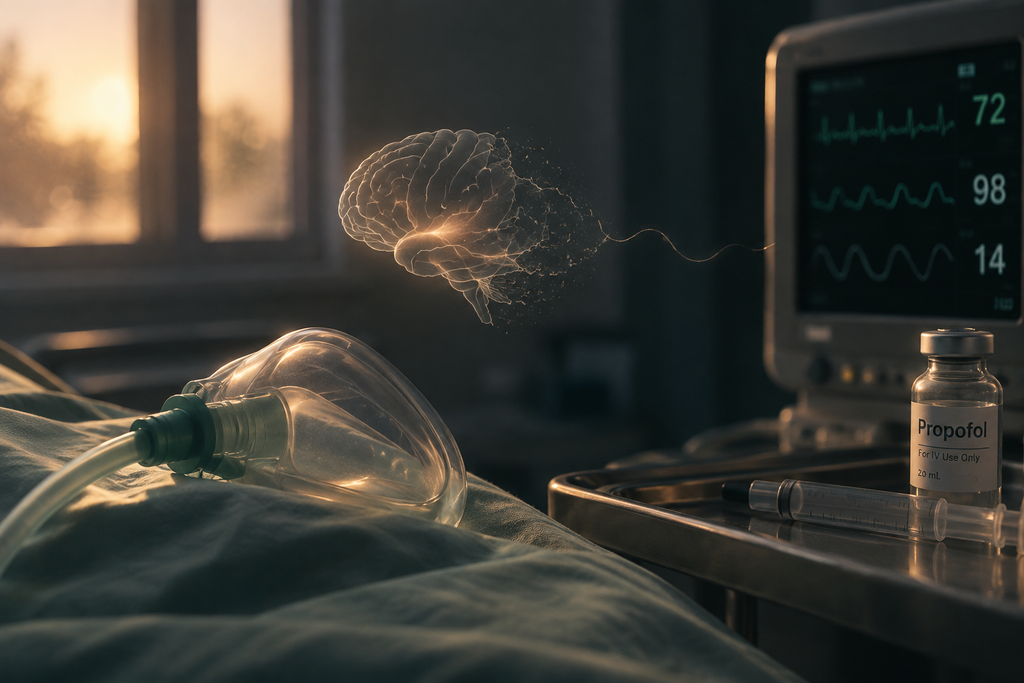
The answer is more complicated — and much more fascinating — than simply saying anesthesia “switches the brain off.”
Anesthesia Isn’t Just Sleep
General anesthesia is a medically induced, reversible state in which a person loses consciousness and responsiveness. It can also affect perception, movement, and memory.
But anesthesia isn’t just an extremely deep version of ordinary sleep.
During sleep, your brain naturally moves through different stages, with characteristic patterns of activity. You can still respond to certain things — a sound, a touch, your own name. Anesthetic drugs do something different. They actively alter neural activity and communication to produce a much deeper state of unconsciousness.

And here’s the strange part:
An anesthetized brain isn’t simply inactive.
Neurons can still fire. The brain continues to consume energy. Different regions continue to show activity.
What changes is the pattern of that activity — and how different parts of the brain communicate.
There Isn’t a Consciousness Switch
It’s tempting to imagine consciousness as a light bulb somewhere inside the brain:
ON → conscious
OFF → unconscious
But neuroscience doesn’t point to a single place where consciousness lives.
Conscious experience appears to depend on coordinated activity across large networks. Information has to be processed and integrated between systems involved in perception, attention, memory, and arousal.
The thalamus acts as an important communication hub, while the cerebral cortex is involved in processes including perception, attention, memory, and conscious awareness.
Under general anesthesia, the activity and communication of these systems can be profoundly reorganized.
The brain isn’t necessarily silent.
Instead, it enters a state in which the large-scale interactions associated with normal conscious awareness are disrupted.
So What Do Anesthetic Drugs Actually Do?
There isn’t one universal “anesthesia molecule.”
Different anesthetic drugs affect different receptors and neural circuits.
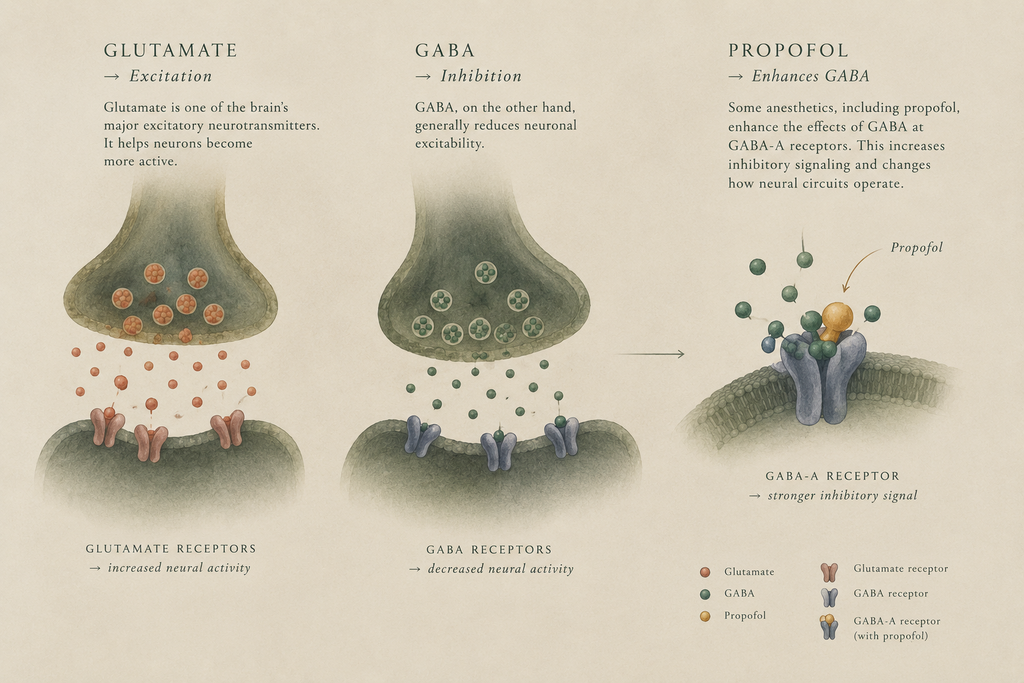
One important system involves GABA, the brain’s major inhibitory neurotransmitter.
Think of neural activity as a balance between acceleration and braking.
Glutamate is one of the brain’s major excitatory neurotransmitters. It helps neurons become more active.
GABA, on the other hand, generally reduces neuronal excitability.
Some anesthetics, including propofol, enhance the effects of GABA at GABA-A receptors. This increases inhibitory signaling and changes how neural circuits operate.
But anesthesia isn’t simply “flooding the brain with GABA.”
Different anesthetics can influence multiple molecular targets and alter how neural activity is coordinated across brain networks.
Ketamine, for example, primarily affects NMDA receptors involved in glutamate signaling and produces a very different altered state of consciousness from drugs such as propofol.
So there isn’t one chemical button labelled:
CONSCIOUSNESS: OFF
Instead, different drugs can push the brain into different states in which normal conscious processing becomes profoundly altered.
When the Brain’s Conversation Changes
Imagine a huge room filled with thousands of people having different conversations.
Everyone is talking.
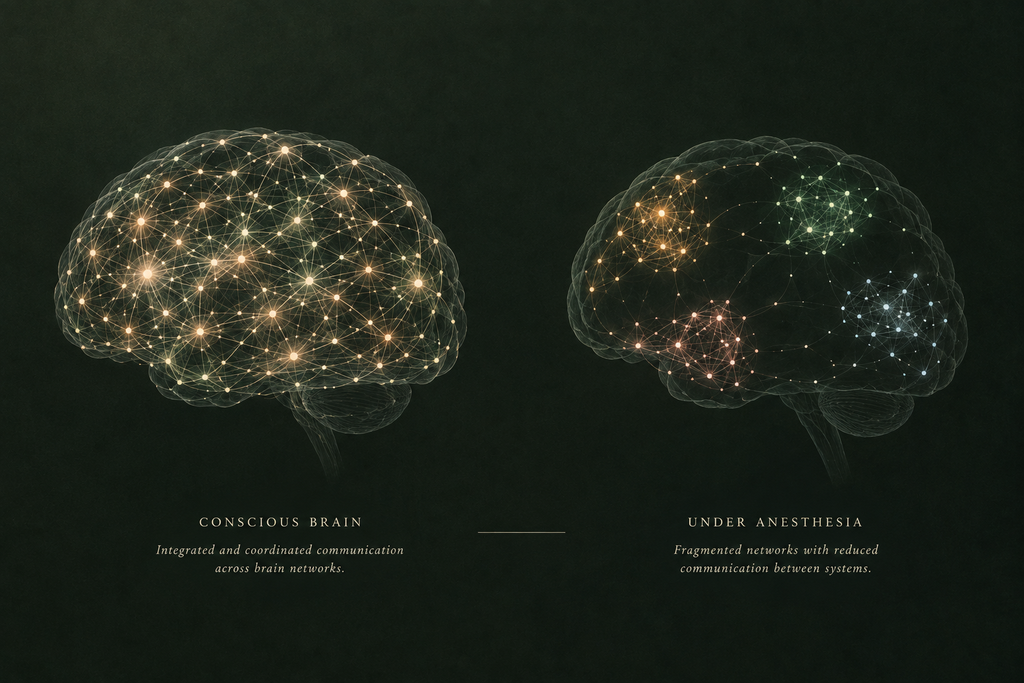
But suddenly, the groups become increasingly isolated. People within each group can still communicate, but information isn’t travelling as freely between groups.
There is still plenty of conversation.
But the room no longer functions as one highly connected system.
Something similar can happen to the brain under anesthesia.
Researchers have observed changes in communication and coordination between large-scale brain networks during anesthetic-induced unconsciousness.
This matters because consciousness appears to involve more than individual neurons simply being active.
The brain has to integrate information across different systems.
This connects anesthesia research with theories such as the Global Neuronal Workspace Theory, which proposes that conscious information becomes widely available across large-scale brain networks.
Another framework, Integrated Information Theory, focuses on how information is integrated within a system and how strongly its different parts influence one another.
Scientists continue to debate exactly how consciousness arises. But anesthesia gives researchers an unusual opportunity to study the question:
What changes when consciousness disappears?
Why Don’t You Remember the Surgery?
There’s another mystery hidden inside anesthesia:
If the brain was still active, why don’t you remember what happened?
Because unconsciousness and amnesia aren’t exactly the same thing.
Memory formation involves several stages, including encoding and consolidation. Brain systems involved in forming new memories — including the hippocampus — can be strongly affected by anesthetic drugs.
So even if sensory information reaches parts of the brain during anesthesia, it may not be processed into a normal conscious experience or stored as a lasting memory.
Rarely patients can experience some degree of awareness during anesthesia, and some may later remember aspects of that experience. This is known as intraoperative awareness. Most cases don’t involve pain, but they can be distressing, and researchers are working on ways to monitor for it more effectively.
For most patients, however, memories of the procedure aren’t formed in the usual way.
Your brain doesn’t necessarily erase an existing recording.
In many cases, the recording was never properly created.
And Then Consciousness Comes Back
Eventually, the anesthetic begins to wear off.
As its effects decrease, the brain gradually moves away from the anesthetized state.
Patterns of neural activity change.
Communication between brain networks becomes more coordinated.
Responsiveness returns.
Awareness follows.
And eventually, you open your eyes.
There isn’t necessarily one mysterious moment when a consciousness switch flips back on.
Instead, multiple systems involved in arousal, perception, attention, memory, and communication gradually recover their ability to work together.
It’s less like turning on a light and more like reconnecting a network.
Is Anesthesia Like Death?
People sometimes describe anesthesia as a “trial run” for death. But that comparison isn’t quite right.
During anesthesia, the brain is still alive and active. The conditions for consciousness are temporarily disrupted — but the machinery that produces it remains intact.
In death, those conditions aren’t disrupted. They’re gone.
Anesthesia is reversible. Death isn’t.
But the comparison is still interesting. If consciousness can be interrupted without the brain being damaged, what does that tell us about the relationship between the brain and experience?
Anesthesia doesn’t answer that question. But it gives us a way to ask it.
The Questions We Still Can’t Answer
And this is where anesthesia becomes more than just a medical tool.
It becomes a way to study consciousness itself.
Researchers are still trying to understand:
- Why do some people report dream-like experiences under anesthesia while others remember nothing? Does this mean consciousness doesn’t fully disappear — or that different brain states produce different kinds of experience?
- Why can awareness occur in some cases even when responsiveness is absent? If a patient can hear but not move, what does that tell us about the relationship between consciousness and behavior?
- Can consciousness be measured objectively from brain activity alone? If we could measure it, what would that mean for patients in comas, vegetative states, or locked-in syndrome?
- What exactly has to happen in the brain for experience to exist at all? Anesthesia gives us a way to study that question — but it doesn’t give us the answer.
Anesthesia doesn’t answer all of these questions.
But it gives scientists something incredibly valuable:
A way to observe the brain as consciousness disappears — and then watch it return.
So Where Did Consciousness Go?
Maybe the strangest thing about anesthesia is that consciousness doesn’t appear to be a physical object that simply leaves the brain.
There isn’t a tiny part of your brain where “you” are stored, waiting to be switched off and on.
Instead, conscious experience emerges from patterns of activity and communication across the brain.
Anesthesia temporarily changes those patterns.
The neurons are still there. The brain is still functioning. The machinery is intact.
But the organized communication that allows you to experience the world can be profoundly altered.
And when those systems recover — when the networks reconnect — you come back.
Not because you were somewhere else. But because the conditions for experience had been temporarily disrupted.
Consciousness isn’t a thing that can be lost.
It’s a process that can be interrupted.
And that might be the strangest thing about being you.
Sources / Further Reading
- Alkire, M. T., Hudetz, A. G., & Tononi, G. (2008). Consciousness and Anesthesia. Science, 322(5903), 876–880.
- Mashour, G. A., & Hudetz, A. G. (2018). Neural Correlates of Unconsciousness in Large-Scale Brain Networks. Trends in Neurosciences, 41(3), 150–160.
- Tononi, G., & Koch, C. (2015). Consciousness: Here, There and Everywhere? Philosophical Transactions of the Royal Society B, 370(1668).
- Dehaene, S., & Changeux, J. P. (2011). Experimental and Theoretical Approaches to Conscious Processing. Neuron, 70(2), 200–227.
- Brown, E. N., Lydic, R., & Schiff, N. D. (2010). General Anesthesia, Sleep, and Coma. New England Journal of Medicine, 363(27), 2638–2650.