
The surprising neuroscience behind the emotions we think we already understand.
Picture this.
You’re having a completely ordinary day. Nothing extraordinary has happened, but you’re in a genuinely good mood. You finish your tasks, laugh at something ridiculous with a friend, and find yourself humming your favorite song on the walk home.
Then your phone buzzes.
You reply to a friend’s message. A few seconds later, the screen lights up with their response:
“K.”
That’s it. One letter.
Suddenly, something inside you shifts.
“Are they annoyed?”
“Did I say something wrong?”
“Have I ruined everything?”

Within minutes, you’re replaying yesterday’s conversations, analyzing punctuation like it’s evidence in a high-stakes courtroom, and convincing yourself that your friendship is falling apart.
Now… pause for a second. Look around you.
The room hasn’t changed. The air hasn’t changed. Nothing in your physical reality has changed.
So why does everything feel completely different? (In a moment, you’ll discover the single 5-word question that breaks this mental spiral. But to see why it works, we have to look inside the dark room where your mind actually lives.)
Your Emotions Aren’t What You Think They Are
Most of us grow up believing emotions simply happen to us. Something good happens—we feel happy. Something bad happens—we feel sad. It seems obvious.
For decades, psychology largely supported this idea. The brain was thought to contain built-in emotional circuits—like pre-wired buttons waiting to be pressed.
- Danger? → Press Fear.
- Success? → Press Happiness.
- Loss? → Press Sadness.
But modern cognitive neuroscience tells a much more fascinating story.
Led by researchers such as neuroscientist Dr. Lisa Feldman Barrett, modern psychology shows that emotions aren’t simply triggered. They are constructed.
Your brain doesn’t merely discover how you feel. It actively creates that feeling on the spot.
Your Brain Never Experiences Reality Directly
This is one of the most mind-bending facts in neuroscience: Your brain has never actually seen a sunset.
It has never heard your favorite song. It has never felt a warm hug.
Locked inside the dark, quiet skull, your brain receives nothing more than streams of electrical signals arriving from your eyes, ears, skin, and internal organs. Its constant job is to answer one impossible question:
“What is happening out there right now?”
The only way it can answer that is by looking backward. Every millisecond, your brain compares incoming sensory noise with every memory and pattern you’ve ever experienced.
When your friend replies with “K.”, the text itself is completely ambiguous. Your brain doesn’t instantly know if they’re busy, driving, or upset. So, driven by a natural negativity bias designed to protect you from social harm, it searches your past:
- Have short replies meant conflict before?
- Have people pulled away from me like this in the past?
Using those memories, your brain makes its best prediction. Psychologists call this affective realism—when your brain’s internal prediction becomes your lived reality.
Your emotions aren’t always direct reflections of what’s happening outside. More often, your emotions are reflections of your brain’s expectations.
Your Body Budget Controls Your Mind
Think back to the last time you felt anxious before an important event. Your heart raced, your stomach tightened, your palms went cold.
We assume those physical reactions happen because we’re anxious. Neuroscience suggests the reverse: Those physical sensations help construct the emotion itself.
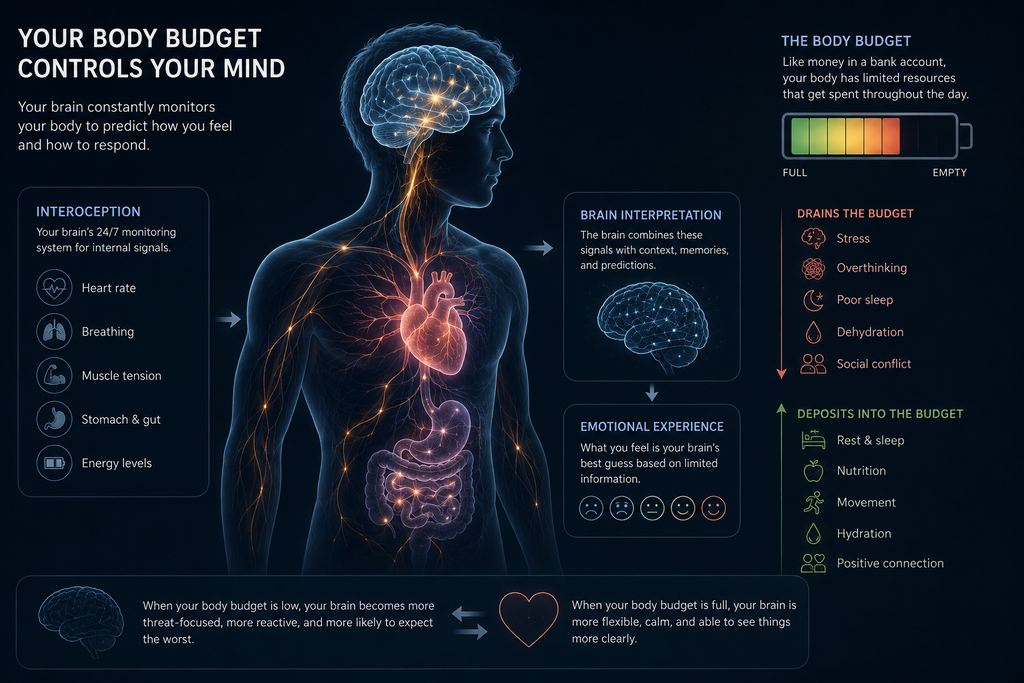
Hidden beneath your conscious awareness is a process called interoception—your brain’s 24/7 monitoring system for your internal organs, blood pressure, and muscle tension.
Scientists compare this process to managing a Body Budget.
- Sleep, nutrition, and rest deposit energy into the budget.
- Stress, dehydration, and overthinking withdraw from it.
When your body budget is low or strained, your brain predicts threat much faster. If you receive an uncertain text when you are tired or hungry, your brain notices your elevated heart rate and asks:
“Given this rapid heart rate and low body energy… what emotion makes the most sense?”
It answers: Anxiety. Anger. Fear. And that prediction becomes your conscious reality.
Meet Your Brain’s Security Guard
You’ve probably heard of the amygdala referred to as the brain’s “fear center.” But modern neuroscience views it differently.
The amygdala is better understood as your brain’s salience network guard. Its job isn’t to create fear—it’s to decide what matters.
It constantly scans the environment asking one question: “Does this require my attention?”
- A sudden loud noise? Alert.
- A smile from someone you love? Alert.
- Footsteps on a dark street? Alert.
- A single-letter text from a close friend? Alert.
The amygdala cannot always tell the difference between a physical threat in the wild and a social threat on a glass screen. It alerts your brain either way—not to ruin your day, but to keep you safe.
Why You Overthink at 2 A.M.
Uncertainty is deeply uncomfortable for a predictive brain.
When information is missing, your brain stays awake running simulation after simulation, trying to fill in the blanks. That’s why a tiny text can keep you staring at the ceiling at 2 a.m.
You aren’t being overly dramatic. Your brain is simply trying to solve an incomplete puzzle.
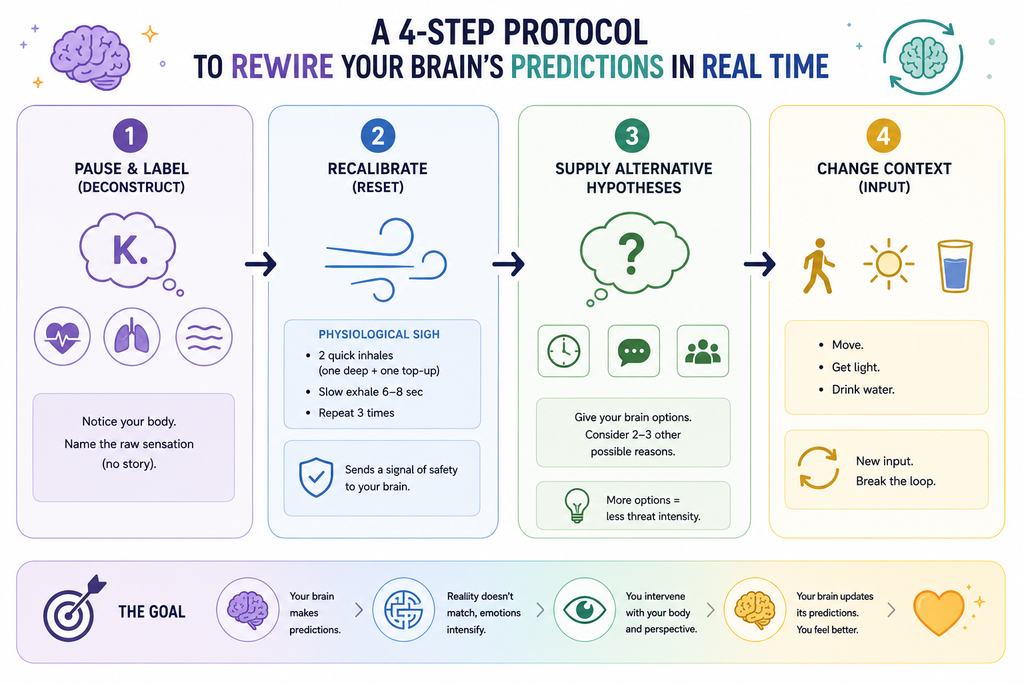
A 4-Step Protocol to Rewire Your Brain’s Predictions in Real Time
Understanding that your brain constructs emotions is liberating—because if your brain built the feeling, you have the power to dismantle it. The next time a single text message or ambiguous comment sends you into an emotional tailspin, use this step-by-step circuit breaker to re-regulate in real time:
1. Pause & Label the Physical Sensation (Deconstruct)
Separate the raw body signal from the mental story. Before your brain turns physical arousal into emotional panic, name the raw sensation without adding a narrative. Say to yourself: “My heart rate is elevated, my chest feels tight, and my breathing is shallow.”
By shifting from emotional labels (“I’m terrified” or “I’m angry”) to physical descriptions (“My heart is beating faster”), you interrupt the brain’s attempt to categorize the state as a negative emotion.
2. Recalibrate Your Body Budget (Interoceptive Reset)
Send a physical signal of safety to the brain. Your brain will keep constructing threat predictions as long as your physical budget feels depleted or stressed. Force a physiological shift using the Physiological Sigh:
- Take two quick inhales through your nose (one deep inhale, followed immediately by a sharp second top-up inhale).
- Slowly exhale through your mouth for 6–8 seconds.
Repeat this 3 times. The extended exhale stimulates the vagus nerve, dropping your heart rate and signaling to the amygdala that there is no physical danger.
3. Supply the Brain with Alternative Hypotheses
Break the single-prediction trap. Uncertainty forces the brain to lock onto its default (and usually worst-case) prediction. Actively force your brain to generate at least 3 alternative explanations for the trigger:
- “They replied with ‘K.’ because they’re rushing into a meeting.”
- “They’re typing with one hand while carrying groceries.”
- “They think ‘K.’ is just a standard, polite acknowledgment.”
You don’t need to know which one is true; giving your brain options immediately lowers the emotional intensity of the primary threat prediction.
4. Change Your Context or Sensory Input
Feed your brain fresh incoming data. Since the brain constructs predictions using current sensory inputs, staying frozen in the exact spot where you received the text keeps the loop alive.
Stand up, stretch, walk to another room, get a glass of cold water, or step outside for 60 seconds. Fresh movement and light force your sensory networks to process new environmental data, breaking the brain’s internal prediction loop.
i liked the website as its helps me overcome the habit of overthinking and learn new things.
that’s wonderful<3