
Why embarrassing memories stick around, why your younger self feels like a stranger, and what your brain is actually doing when you cringe.
You trip slightly while walking into a crowded coffee shop or a high-stakes board room. Nobody laughs. Nobody points. In fact, if you were to check security camera footage, not a single head even turned. Yet, for the next three hours, your chest feels constricted, your heart races, and you are utterly convinced that every eye in the room is dissecting your awkwardness. You replay that split-second stumble on an agonizing, continuous loop, avoiding eye contact, over-correcting your posture, and walking just a bit too stiffly for the rest of the day.
The funny thing is, everyone else genuinely forgot the micro-event within three seconds—if they noticed it at all. So why does your mind refuse to let it go? Why does a minor physical or verbal slip-up trigger an avalanche of self-conscious paranoia that feels impossible to shut down?
The Paradox of Self-Consciousness: We live under the delusion that we are actors on a stage surrounded by an attentive audience. In reality, we are extra actors in a crowded room where everyone else is panicking about their own lines.

The Tribe in Your Head
To understand why your brain can turn an awkward social moment into a much bigger threat, you have to look at the environment in which human psychology evolved.
Your brain wasn’t designed for classrooms, open-plan offices, parties, or Instagram feeds. It evolved in environments where belonging to a group could make a real difference to survival.
For early humans, being rejected or separated from your group could have serious consequences. People depended heavily on one another for food, warmth, protection, cooperation, and raising children.
Because of this, humans developed highly sensitive systems for detecting signs of rejection and social disapproval. Being accepted by the group mattered, so the brain became very good at noticing anything that might signal exclusion.
But here’s the strange part: your brain doesn’t always know when the stakes have changed.
Today, being left out of a conversation isn’t the same as being abandoned in the wilderness. Saying something awkward in class isn’t a survival emergency. And someone glancing at you doesn’t necessarily mean they’re judging you.
Yet your nervous system can still react as though social rejection matters far more than it objectively does.
The tribe may have changed. The brain’s alarm system hasn’t completely caught up.
The Spotlight Effect & The Illusion of Transparency
In cognitive psychology, this cognitive distortion is known as the Spotlight Effect. Pioneered by social psychologists Thomas Gilovich and Kenneth Savitsky at Cornell University, this bias causes us to wildly overestimate how much other people notice our appearance, errors, and behavioral quirks.
Academic Citation — Cornell University:
Gilovich, T., Medvec, V. H., & Savitsky, K. (2000). “The Spotlight Effect in Social Judgment: An Egocentric Bias in Estimates of the Salience of One’s Own Actions and Appearance.” Journal of Personality and Social Psychology, 78(2), 211–222.
In a seminal experiment at Cornell, researchers made college students wear an intentionally embarrassing t-shirt (featuring a giant image of singer Barry Manilow) before entering a room full of peers. Afterwards, the t-shirt wearers estimated that at least 50% of the room noticed their embarrassing attire. The actual result? Less than 23% had any recollection of what was on the shirt.
Closely tethered to this is the Illusion of Transparency. Research from Stanford University demonstrates that when we feel nervous, guilty, or embarrassed, we operate under the false assumption that our internal emotional state is visibly bleeding out into the external world.
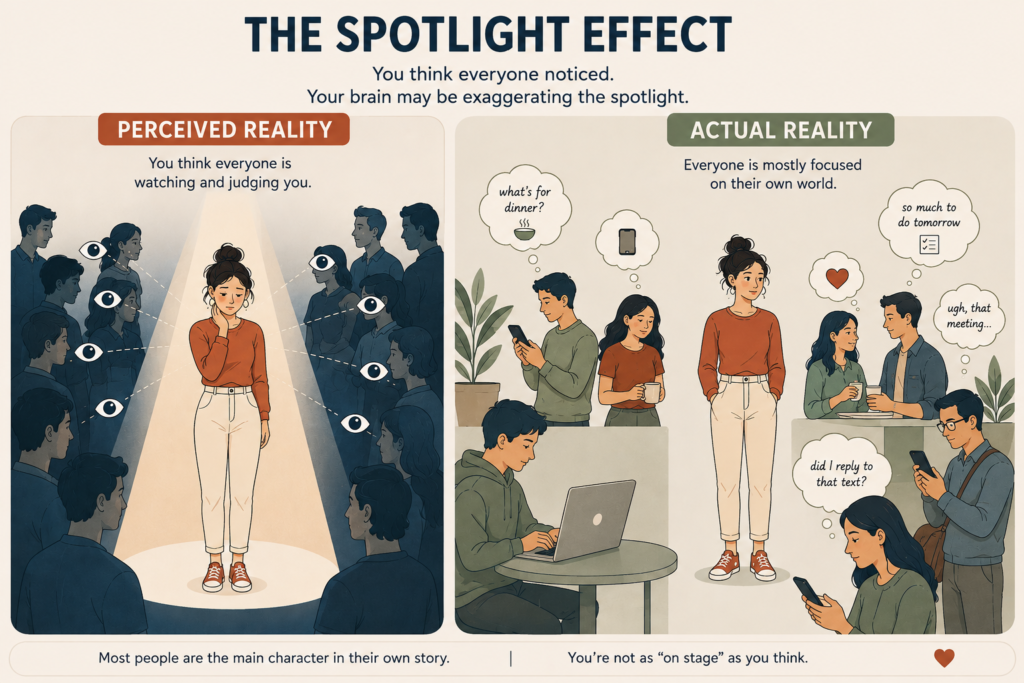
Here is the liberating reality check: Everyone else is standing under their own imaginary spotlight. They aren’t dissecting your outfit, your vocal pitch, or your walking gait because they are frantically worrying about their own hair, their own financial pressures, or an awkward comment they made five minutes ago. Just like you, they are completely trapped inside their own internal universe.
Predictive Processing: Your Brain Is a Reality Generator
Modern neuroscience has challenged the classic view that the brain is a passive camera receiving external reality. Leading neuroscientists such as Dr. Karl Friston (University College London) and Dr. Lisa Feldman Barrett (Northeastern University / Harvard Medical School) have developed influential theories around Predictive Processing and the Free Energy Principle.
Academic Citation — University College London & Harvard / Northeastern:
Friston, K. (2010). “The free-energy principle: a unified brain theory?” Nature Reviews Neuroscience, 11(2), 127–138.
Barrett, L. F. (2017). How Emotions Are Made: The Secret Life of the Brain. Pan Books.
Research by Friston and Barrett has helped shape our understanding of the brain as an active prediction-making system. Friston’s work describes how the brain continually generates predictions about the world, while Barrett’s research explores how the brain constructs emotional experiences using sensory information, past experiences, and expectations.
Your brain does not passively observe what is happening around you; it actively constructs reality through top-down sensory predictions. Every millisecond, your brain combines:
1. Past Traumas & Memories: That time you were laughed at in 5th grade public speaking.
2. Interoceptive Signals: Heart rate, gut tightness, baseline fatigue.
3.Contextual Clues: Ambiguous environmental signals like a quiet room or a stranger’s quick glance.
It blends these elements together to generate a predictive hypothesis:
Realitypredicted=f(Sensory Input)+Prior Expectations
When you step into a room full of strangers and feel a wave of social anxiety, you are not reacting to active, real-time judgment from the room.
You are experiencing your brain’s internal simulation—running an old evolutionary script that predicts judgment as a protective mechanism.
Negativity Bias & The Error Management Theory
Why are your brain’s predictions so pessimistic? Why doesn’t it predict that everyone loves your outfit?
The answer lies in Error Management Theory (EMT), developed by evolutionary psychologists Martie Haselton and David Buss (UCLA and UT Austin).
Academic Citation — UCLA & UT Austin:
Haselton, M. G., & Buss, D. M. (2000). “Error management theory: A new perspective on biases in cross-sex mind reading.” Journal of Personality and Social Psychology, 78(1), 81–91.
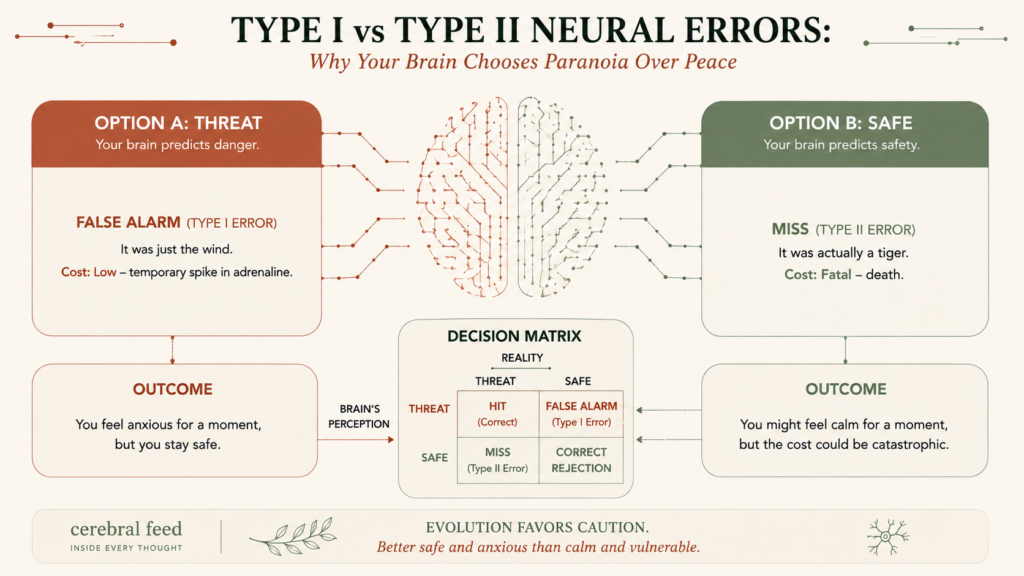
In decision-making under uncertainty, there are two types of errors:
- Type I Error (False Positive): Believing a harmless rustle in the bushes is a dangerous tiger when it is just the wind. Cost: Low: a temporary spike in adrenaline.
- Type II Error (False Negative): Believing a rustle in the bushes is just the wind when it is actually a hungry tiger. Cost: Potentially fatal.
As a result of millions of years of selection pressure, your neural architecture is asymmetrical: it is biased toward Type I errors. In a social setting, your brain decides that mistaking a neutral or busy glance for cold judgment is a low-cost mistake. Missing a genuine signal of social rejection is treated as catastrophic.
“Protection does not equal accuracy. Your brain would far rather keep you safe and anxious than calm and vulnerable.”
The Neural Circuitry of Social Pain
When you experience perceived social rejection or fear judgment, your brain isn’t using metaphorical language—it uses the same physical circuitry that registers physical agony.
Neuroimaging research by Dr. Naomi Eisenberger at UCLA using fMRI scans revealed that social rejection activates the dorsal Anterior Cingulate Cortex (dACC)—the precise region of the central nervous system involved in processing the emotional distress associated with physical pain, such as a broken bone or a burn.
Research by Eisenberger, Lieberman, and Williams provides evidence for this connection between social exclusion and neural systems involved in physical pain.
Academic Citation — UCLA Cognitive Neuroscience:
Eisenberger, N. I., Lieberman, M. D., & Williams, K. D. (2003). “Does Rejection Hurt? An fMRI Study of Social Exclusion.” Science, 302(5643), 290–292.
When you feel like people are judging you, your brain can treat the moment as a genuine source of distress. Understanding this neural link allows you to depersonalize the sensation: you aren’t “weak” or “crazy”; your brain is simply generating a distress signal through circuitry that evolved to respond to threats to social connection.
Breaking the Spiral: Cognitive Reframing Protocols
How do we override millions of years of evolutionary wiring and recalibrate our predictive brains? You cannot simply tell yourself “don’t care what people think.”
Instead, you can use targeted cognitive strategies grounded in Cognitive Behavioral Therapy (CBT) and metacognitive awareness.

Protocol 1: The Objective Evidence Audit
When you feel a spiral of self-consciousness initiating, interrupt the narrative loop by asking:
“What objective, court-admissible evidence do I possess right now that confirms judgment?”
Distinguish between Internal Interoceptive Feeling (“I feel flushed and awkward”) and External Fact (“One person glanced up because a door opened”). Usually, you will find 0% physical evidence.
Protocol 2: De-centering & Task-Concentration Training (TCT)
Shift your attentional spotlight outward. Social anxiety forces your attention inward (monitoring your own breath, posture, facial expression). Force your brain to focus on external sensory variables: count three blue objects in the room, listen to the ambient background noise, or focus intensely on the person speaking to you.
Protocol 3: The 10/10/10 Perspective Rule
Ask yourself: Will anyone in this room remember my minor stumble in 10 minutes?
In 10 days? In 10 years? In 99.9% of scenarios, the lifespan of someone else’s memory of your flaw is less than 120 seconds.
The Great Social Liberation
Your mind isn’t broken, and it isn’t your enemy. It is a brilliant, primitive machine doing the protective job evolution assigned to it millions of years ago. You don’t need to wage war against your brain or force it to stop making frantic guesses. You simply need to recognize when those guesses are flat-out wrong.
The next time you trip, fumble a sentence, or feel an awkward silence stretch across a room, take a breath and smile. The spotlight isn’t on you. Everyone else in the room is far too busy worrying about their own spotlight to notice yours.
Academic References & Further Reading
- Barkow, J. H., Cosmides, L., & Tooby, J. (1992). The Adapted Mind: Evolutionary Psychology and the Generation of Culture. Oxford University Press.
- Barrett, L. F. (2017). How Emotions Are Made: The Secret Life of the Brain. Pan Books.
- Eisenberger, N. I., Lieberman, M. D., & Williams, K. D. (2003). Does Rejection Hurt? An fMRI Study of Social Exclusion. Science, 302(5643), 290–292.
- Friston, K. (2010). The free-energy principle: a unified brain theory? Nature Reviews Neuroscience, 11(2), 127–138.
- Gilovich, T., Medvec, V. H., & Savitsky, K. (2000). The Spotlight Effect in Social Judgment: An Egocentric Bias in Estimates of the Salience of One’s Own Actions and Appearance. Journal of Personality and Social Psychology, 78(2), 211–222.
- Haselton, M. G., & Buss, D. M. (2000). Error management theory: A new perspective on biases in cross-sex mind reading. Journal of Personality and Social Psychology, 78(1), 81–91.