
You know the feeling.
A song comes on—maybe one you’ve heard a hundred times, maybe one you haven’t heard in years—and something shifts. Your shoulders let go. Your mood lifts. A memory surfaces before you even realize what triggered it.
Nobody’s telling you how to feel. Nobody’s asking you to justify yourself.
It’s just sound.
And yet, somehow, it feels like being understood.
That feeling isn’t just poetic. Music taps into brain systems involved in prediction, reward, emotion, movement, attention, and memory. A few minutes of a song can shift how you feel in the moment, while years of listening can weave music into your identity.
But why?
Your Brain Doesn’t Just Hear Music
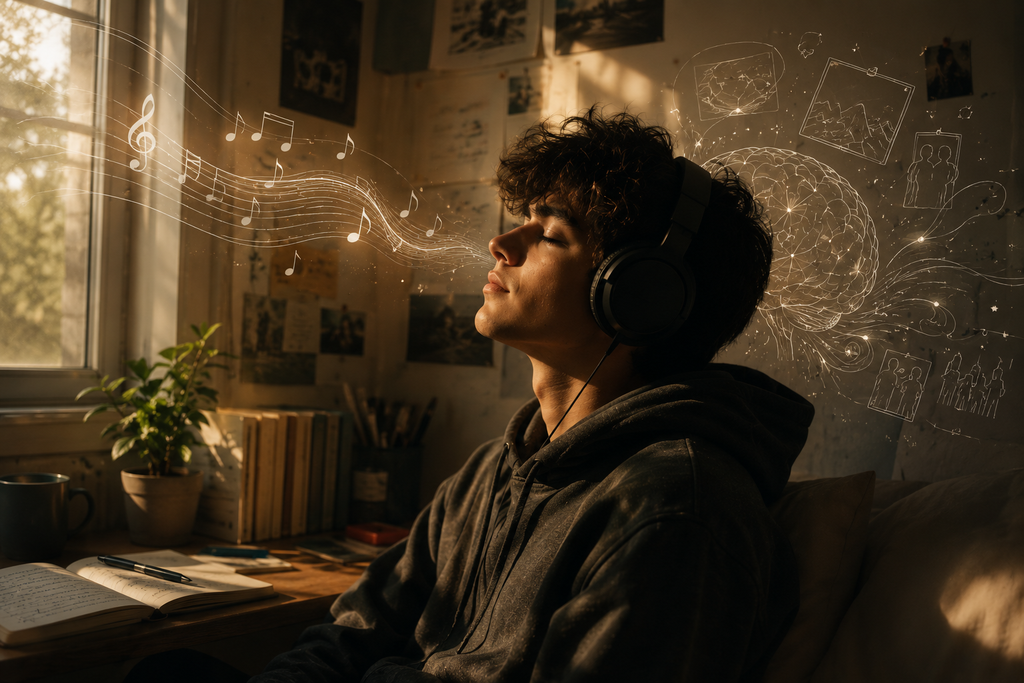
Music isn’t just sound hitting your ears.
When you listen, your brain coordinates activity across a vast network. The auditory cortex decodes the sounds themselves. Motor areas track the rhythm—sometimes making you tap your foot or nod your head without thinking. Emotion-related regions respond to the feeling of the music, while the prefrontal cortex works to anticipate patterns and predict what comes next.
In other words, listening to music isn’t passive.
Your brain is constantly processing, predicting, comparing, remembering, and responding.
That’s part of why music can feel so powerful.
The Dopamine Before the Drop
Think about the moment right before your favorite part of a song.
You know the chorus is coming.
Maybe you can already feel the beat building. You know exactly when the melody is about to change.
And then it hits.
That anticipation matters.
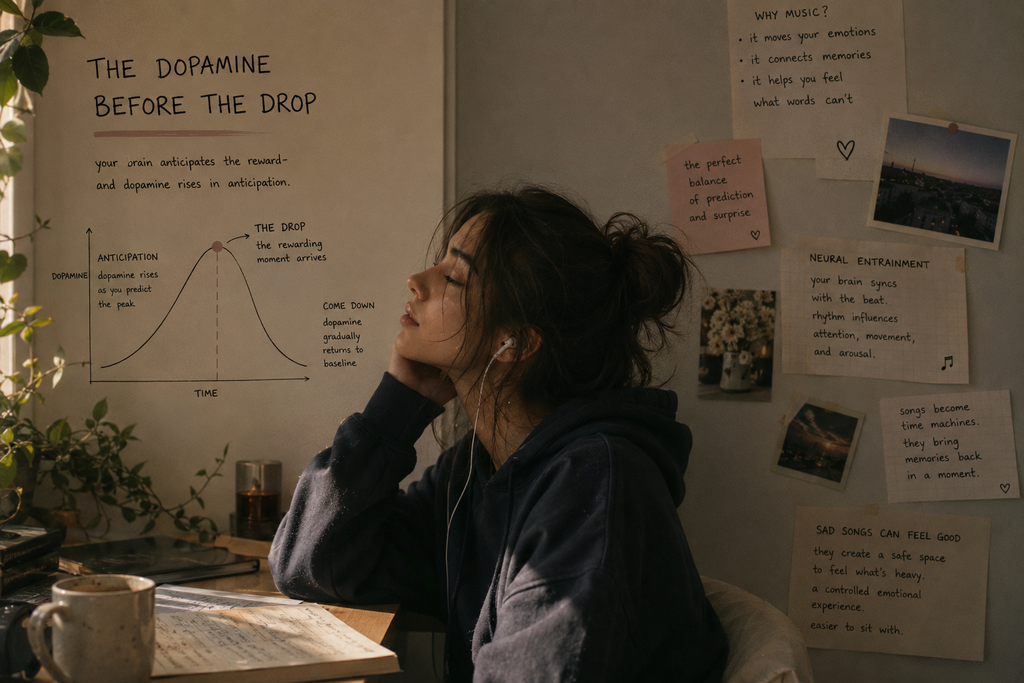
Music engages the brain’s reward system, including dopamine pathways linked to both anticipation and pleasure. Research shows that dopamine activity spikes before a particularly rewarding musical moment—sometimes even more than during the moment itself.
And here’s the interesting part: your brain doesn’t need complete surprise.
In fact, the perfect balance between prediction and surprise may be what makes music so satisfying.
Too predictable, and the song becomes boring.
Too unpredictable, and it feels chaotic.
But when a song gives your brain enough structure to anticipate what’s coming—while still surprising you in satisfying ways?
That’s when the brain lights up.
So that moment before the drop isn’t just musical suspense.
Your brain is already there, waiting for it.
Why You Replay the Same Song
If you’ve played your favorite song 47 times this week, your brain isn’t necessarily tired of it.
It might actually be enjoying the familiarity.
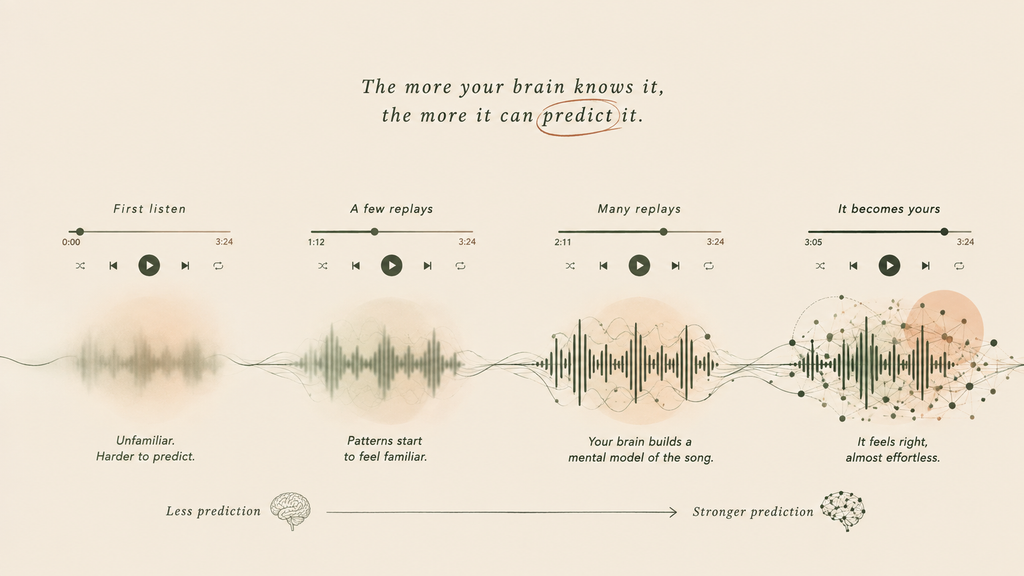
Repeated listening allows your brain to become deeply familiar with a song’s structure—its rhythm, melody, emotional peaks, and quiet moments. You know exactly what’s coming, which means your brain can anticipate the experience.
And anticipation itself is rewarding.
This is why we don’t always want new music. Sometimes, knowing exactly what comes next is part of the pleasure.
Your favorite song isn’t enjoyable despite being familiar.
Its familiarity might be exactly why it feels so good.
Your Brain Has an Inner Rhythm
Music isn’t the only thing with rhythm.
Your brain has it too.
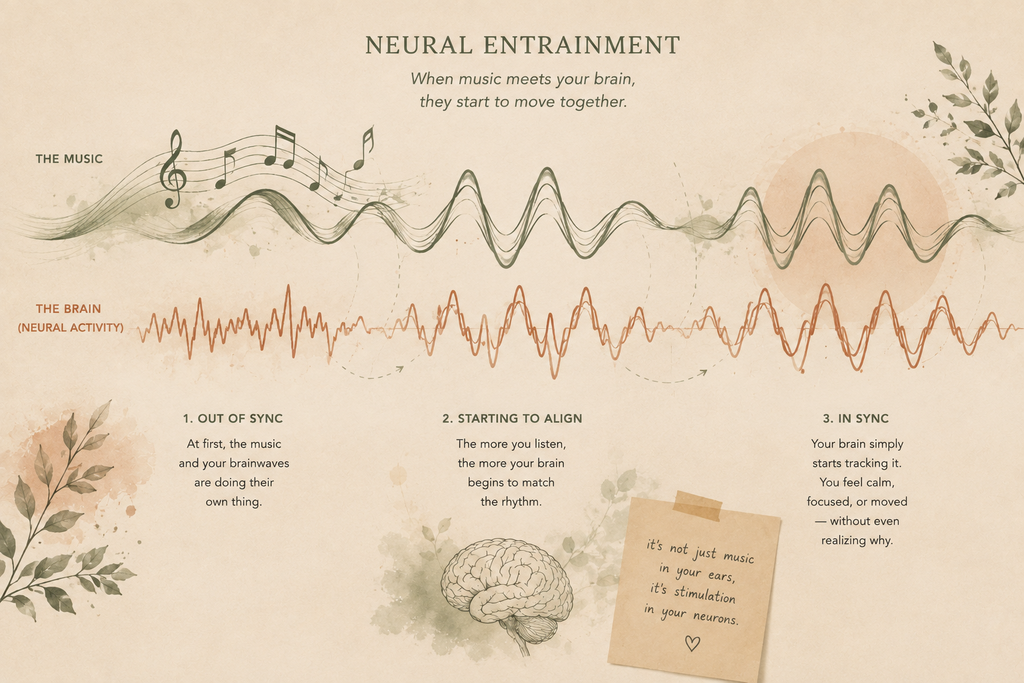
Neural activity naturally pulses in rhythmic patterns. When you listen to a beat, aspects of your brain activity can synchronize with the timing of the music.
This is called neural entrainment.
It helps explain why rhythm influences attention, movement, and arousal.
A fast, energetic song makes you want to move.
A slow, steady piece can feel calming.
And sometimes you don’t consciously decide to follow the rhythm at all.
Your brain simply starts tracking it.
When Music Says What You Can’t
Here’s one of the most interesting things about music: it doesn’t need words.
You can be unable to explain exactly why you’re upset—and still find a song that somehow matches the feeling.
Music becomes a tool for emotional regulation. People use it intentionally to change, maintain, or process emotions—to energize themselves, calm down, focus, or simply sit with a feeling.
And this is where personal preference matters.
A song that comforts one person might irritate another.
There’s no single “calming” song for everyone, because music carries personal meaning.
Your brain doesn’t just hear the notes.
It remembers what those notes mean to you.
The Song That Became a Time Machine
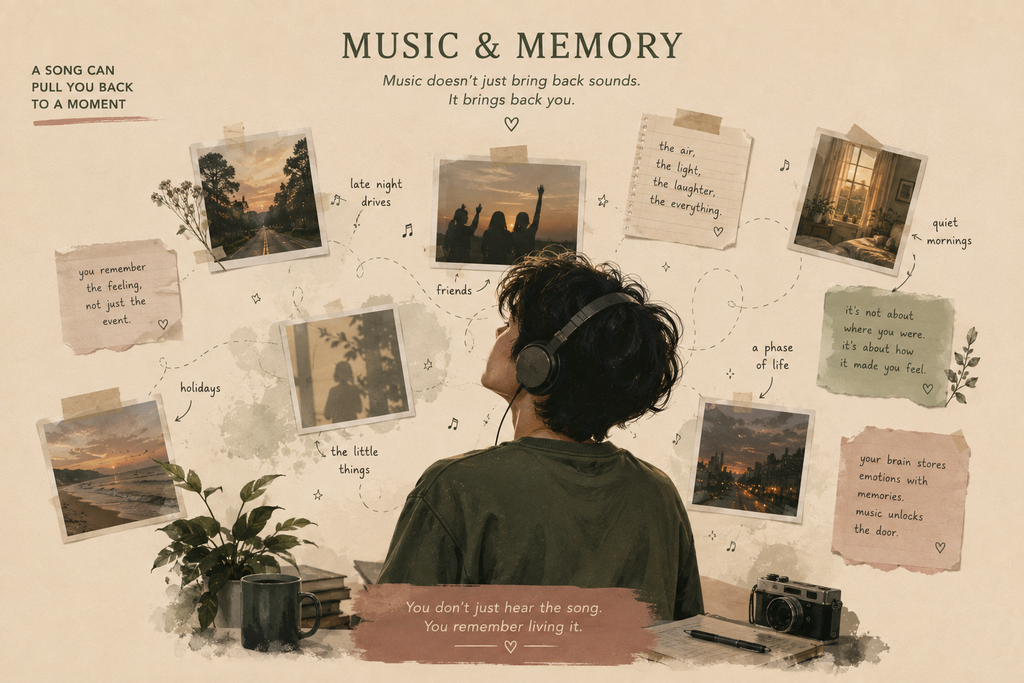
Ever heard a song after years of not listening to it—and suddenly remembered exactly where you were when you first heard it?
That’s not a coincidence.
Music is deeply connected to autobiographical memory—memories of your own life.
A song becomes associated with a person, a place, a time, or an emotion. When you hear it again, those associations come flooding back.
That’s how a three-minute song can feel like a portal.
You’re not literally travelling back in time.
But your brain is reconstructing pieces of a past experience—its sounds, emotions, images, and context.
And because music is such a powerful sensory cue, it can bring those memories back with remarkable clarity.
Why Sad Songs Can Feel Good
Here’s the strange part.
Sometimes we deliberately listen to music that makes us sad.
Why would anyone do that?
Because experiencing an emotion through music isn’t the same as experiencing it in real life.
A sad song creates a controlled emotional experience. You can feel sadness, nostalgia, longing, or tenderness while staying physically safe from the situations that usually trigger those feelings.
For many people, that experience feels comforting or deeply meaningful.
Music gives emotion somewhere to go.
It doesn’t necessarily make the sadness disappear.
But it can make the feeling easier to sit with.
Music Can Change More Than Your Mood
Music’s effects don’t stop when the song ends.
Research into music-based interventions and musical training has found changes in attention, emotional regulation, movement, and cognitive function—though the effects depend heavily on the type of music, the person, and the context.
Here’s an important distinction: listening to your favorite playlist isn’t the same as music therapy.
Music therapy is a structured clinical intervention delivered by a trained professional. Everyday music listening is different—but it can still be a powerful part of how people regulate emotions and connect with memories.
Why Your Favorite Song Is Different
Your brain doesn’t experience every song equally.
It has learned your preferences.
It knows which sounds you love. Which rhythms you naturally follow. Which melodies make you anticipate the next moment. Which songs are tied to specific memories.
That’s why a generic “relaxing playlist” doesn’t necessarily have the same effect as your favorite song.
Your favorite music has history with your brain.
Every replay deepens familiarity.
Every emotional experience adds another layer.
Every memory gives the song more meaning.
Eventually, the song becomes more than sound.
It becomes a collection of predictions, emotions, memories, and experiences—compressed into a few minutes of audio.
It’s More Than a Song
Your brain is constantly predicting.
Your emotions are constantly shifting.
Your memories are constantly being reconstructed.
Music somehow manages to touch all three.
It activates reward systems before your favorite part even arrives. It synchronizes with your brain and body rhythms. It helps you regulate emotion without needing words. And it unlocks memories you didn’t even realize were still there.
Music doesn’t magically fix your feelings.
And it isn’t a replacement for professional help when you need it.
But sometimes, a song gives an emotion a shape.
Sometimes it gives a memory a doorway.
And sometimes, when you can’t quite explain what’s happening inside your head, three minutes of sound somehow says it for you.
Maybe that’s why we don’t just listen to our favorite songs.
Sometimes, we return to them.