
You remember things.
Your first day at a new school. A conversation from years ago. The layout of a childhood bedroom.
A song that instantly transports you back to a particular summer.
When these memories surface, they feel real. Vivid. Like you’re watching a clip from a movie
you’ve stored in your head.
But that’s not what’s happening.
Your memory isn’t a video archive. It’s not a hard drive. And every time you remember something,
your brain isn’t playing back a recording—it’s rebuilding the past from scattered fragments.
And here’s the unsettling part: every time you rebuild it, you can change it.
Your Brain Doesn’t Store Memories Like Files
It would be convenient if memories worked like a computer.
Experience → Save → Retrieve.
Simple. Clean. Reliable.
But your brain doesn’t work that way.
When you experience something, your brain doesn’t store a complete video. Instead, it processes
different pieces—what you saw, heard, felt, thought, where you were, who was there.
These fragments become connected through networks of neurons.
Later, when you try to remember, your brain doesn’t pull up a perfect copy. It reconstructs the
experience from those stored pieces, filling in the gaps with whatever seems to fit.
That reconstruction can be remarkably accurate.
But it can also be completely wrong.

Remembering Is an Active Process
Think about a conversation you had last week.
You don’t remember every single word. You remember the gist—what it was about, how you felt, a
few specific phrases.
Your brain fills in the rest.
This is why memory scientists describe memory as reconstructive. You’re not replaying a
recording. You’re assembling a puzzle with missing pieces—and your brain supplies whatever feels
right in the moment.
And every time you assemble it, there’s room for error.
Every Time You Remember, You Can Change the Memory
When you retrieve a memory, it temporarily becomes flexible before being stored again. This
process is called reconsolidation.
In simple terms: Retrieve → Modify → Re-store.
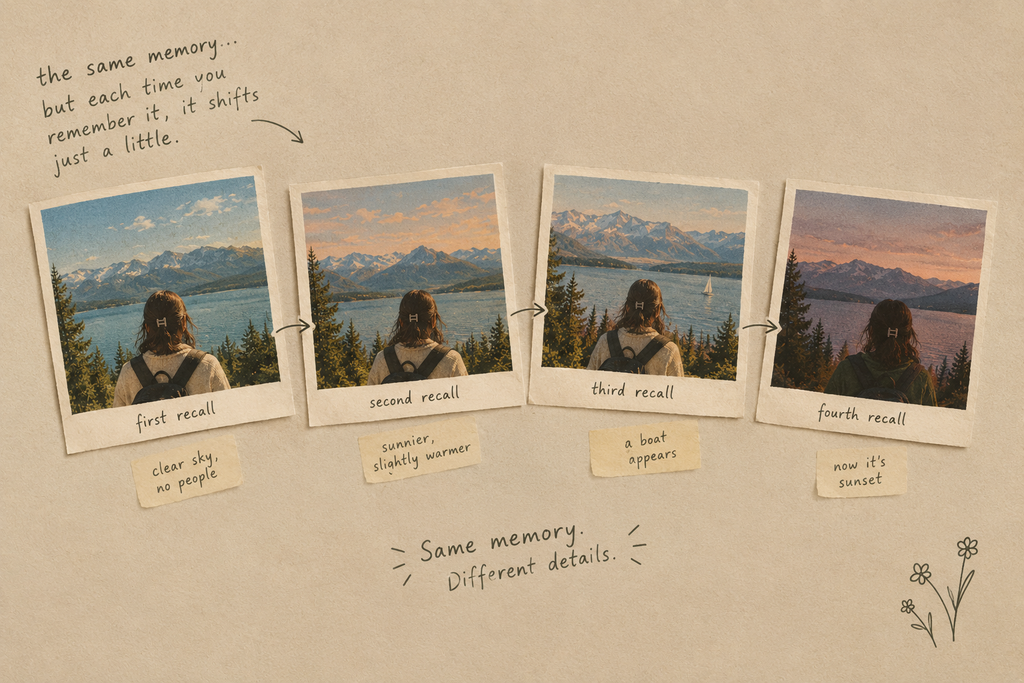
Information present when you recall an experience—your current mood, new knowledge, even
suggestions from others—can sometimes become incorporated into the memory.
This doesn’t mean every memory changes dramatically every time. But it means memory is
dynamic, not permanent.
That’s useful when you learn new information that clarifies the past.
It’s less useful when you accidentally distort what actually happened.
Your Brain Can Add Information That Wasn’t There
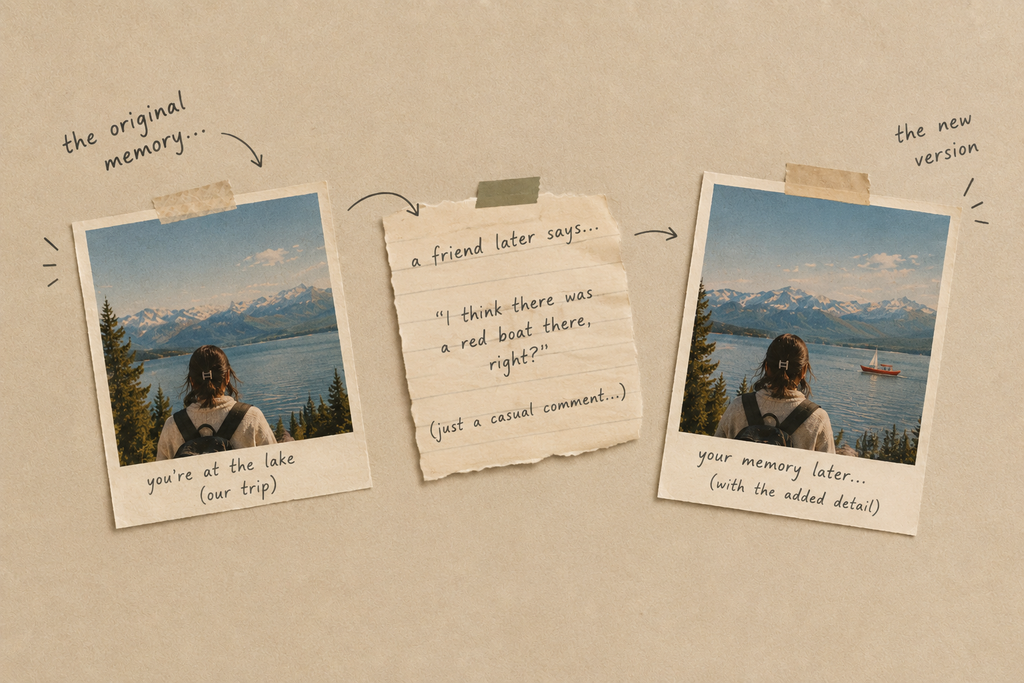
Someone tells you a detail about an event you experienced. Later, you might remember that detail
as though you personally experienced it.
This is called the misinformation effect.
Research has repeatedly shown that information introduced after an event can influence what
people later remember about it.
Your brain doesn’t label every detail with a source. It doesn’t separate:
” This came from the original experience.”
from
” This came from something someone told me later.”
Instead, remembering involves pulling together information from multiple sources—and sometimes
those sources get mixed up.
You’re not intentionally lying.
Your brain is simply doing what it was designed to do: construct a coherent story from
available fragments.
Confidence Doesn’t Equal Accuracy
You can feel extremely confident about a memory and still remember parts of it incorrectly.
Confidence and accuracy are not the same thing.
A memory can feel vivid because it contains strong emotional or sensory details. But vividness
doesn’t guarantee every detail is correct.
This is why eyewitness testimony is so complicated. Someone can genuinely believe they
remember something accurately—without intentionally making anything up.
Their memory simply reflects how their brain reconstructed the experience.
A confident memory is still a reconstruction.
Why Emotional Memories Feel So Real
Some memories feel unforgettable.
A major achievement. An embarrassing moment. A frightening experience. A conversation that
changed everything.
Strong emotions grab the brain’s attention and can become deeply connected to surrounding
details.
This makes certain memories feel unusually vivid.
But vividness ≠ accuracy.
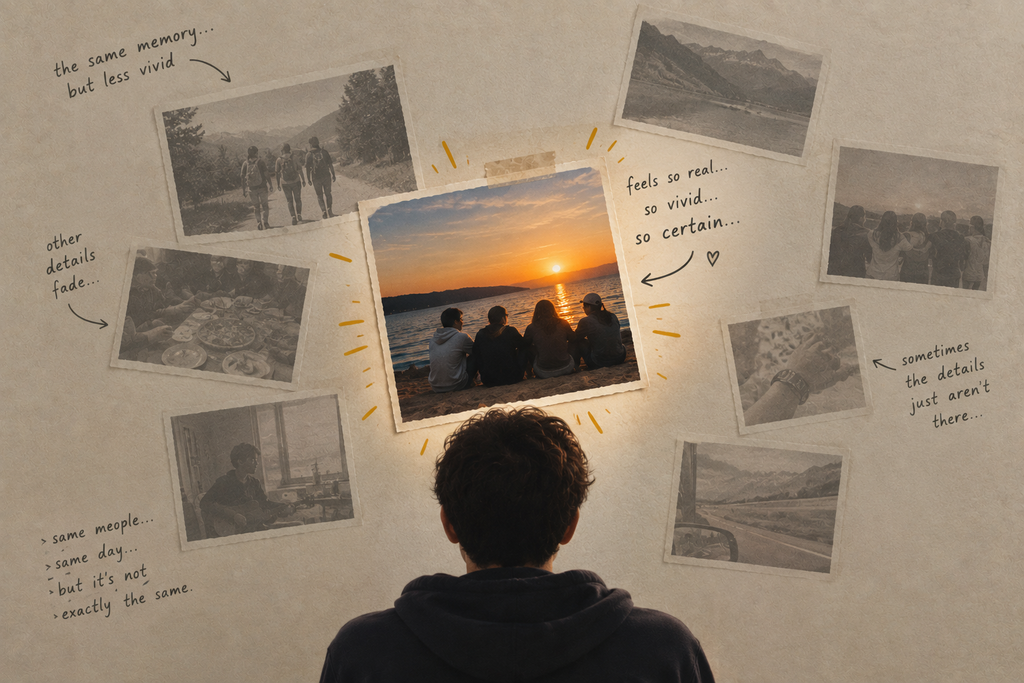
You might remember the overall experience extremely strongly while still misremembering smaller
details—the exact words someone said, the order of events, or even the timeline.
Your brain preserves the meaning of an experience without preserving every detail perfectly.
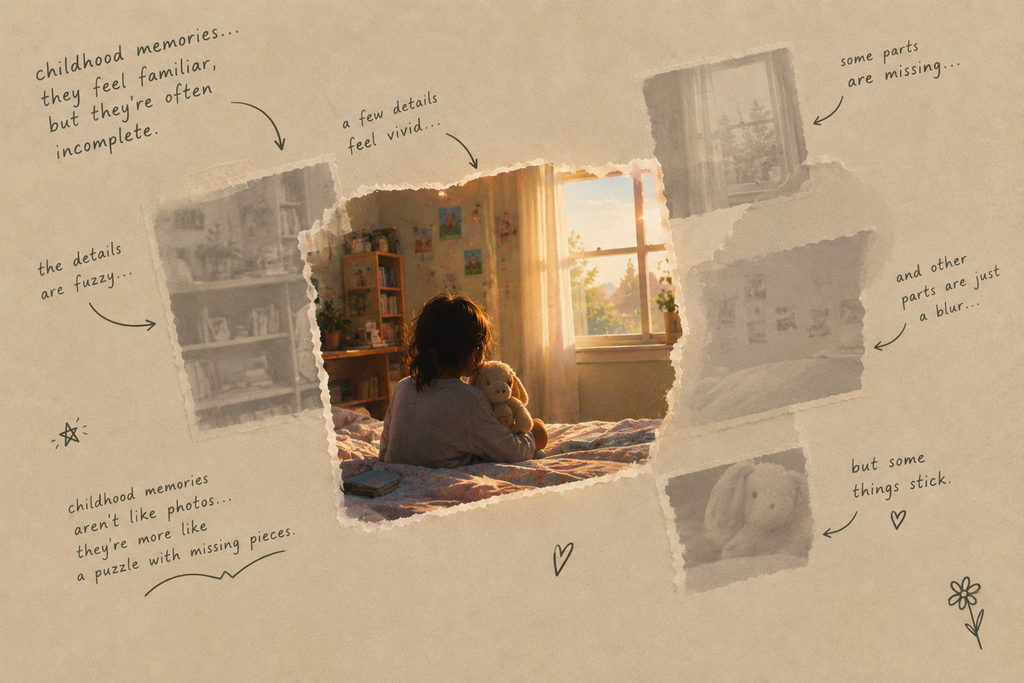
The Strange Case of Your Childhood Memories
Think about one of your earliest memories.
Maybe you can picture the room. Maybe you remember who was there. Maybe you can even recall
what you were wearing.
But here’s the question: how much of that memory comes from the original experience—and
how much has been shaped by photographs, family stories, and repeated retellings?
You may not be able to tell.
This is why early memories are especially difficult to trust. You’ve revisited them so many times,
often with external input, that the boundary between what you experienced and what you later
learned becomes blurred.
Your Memory Has a Source Problem
Your brain doesn’t just need to remember what happened.
It also needs to remember where the information came from.
- Did you actually see it?
- Did someone tell you about it?
- Did you read it somewhere?
- Did you imagine it?
- Did you see a photograph?
This is called source monitoring.
When source monitoring goes wrong, information can feel familiar without you correctly
remembering its origin. You might remember a detail but forget whether you personally
experienced it or simply heard about it.
The information feels real.
The source is what gets lost.
Why Repetition Can Make a Memory Feel Stronger
The more often you think or talk about something, the more familiar it becomes. And familiarity can
influence how believable something feels.
This doesn’t mean repetition automatically creates false memories. But repeated exposure,
retelling, and discussion can influence which details become most accessible.
Over time, your memory may become less:
” This is exactly what happened.”
and more:
” This is the version of what happened that I’ve reconstructed over time.”
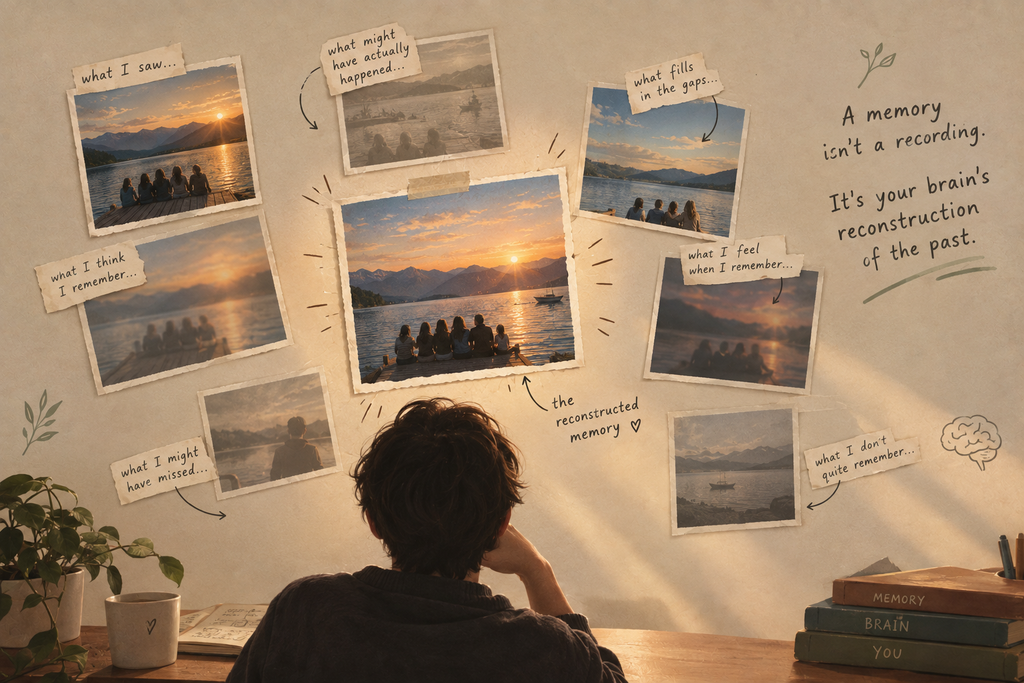
Then What Is a Memory?
A memory isn’t a stored event.
It’s the result of several processes working together:
- Encoding — taking in information
- Consolidation — stabilizing and strengthening some of it
- Storage — maintaining it within changing neural networks
- Retrieval — bringing it back into an active state
And during retrieval, your brain reconstructs the experience using both stored information and the
context available now.
That’s why memory isn’t just about the past.
The present influences how you remember the past.
So Can You Trust Your Memories?
Yes—but not blindly.
Your memories are incredibly useful. They help you learn from experience, recognize people,
understand your history, and build a sense of who you are.
The fact that memory isn’t perfectly recorded doesn’t make it useless.
It makes it human.
Your brain wasn’t designed to preserve every second of your life with perfect accuracy. It prioritizes
what seems meaningful, connects information, updates what it already knows, and reconstructs
the past when you need it.
Most of the time, that works remarkably well.
Sometimes, it doesn’t.
Your Memories Aren’t Recordings
You don’t carry a perfect archive of your past inside your brain.
You carry patterns, associations, knowledge, emotions, and fragments of experiences—raw
material your brain can use to reconstruct what happened.
And every time you remember, you’re not pressing play.
You’re rebuilding.
That’s why two people can remember the same event differently.
Why a memory can become less accurate without becoming less vivid.
Why something you were told years ago can eventually feel like something you personally
remember.
And why your most confident memory isn’t necessarily your most accurate one.
Your memories help tell your story.
But they aren’t perfect copies of it.
They’re reconstructions of a past your brain is constantly trying to understand.
What This Means for You
This isn’t meant to make you doubt everything you remember.
It’s meant to make you think differently about it.
If memory is reconstruction, then:
- Your negative memories might be more distorted than you realize.
- The stories you tell yourself about your past can change.
- You can reframe how you remember difficult experiences.
That’s not denial. That’s not lying to yourself.
It’s recognizing that your memory is a living process—and that you have more influence over it
than you might think.
You can’t change what happened.
But you can change how you remember it.
And sometimes, that changes everything.
i have learned to write blogs for my english language exams after reading this blog.
thats why i feel its wonderfull
glad to be of help 🙂